Silphion — the seed, and how this atlas is arranged

The heart we still draw began as a seed. It is the seed of silphion, the plant of Cyrene, stamped on the city's silver two and a half thousand years ago, grown nowhere else, and lost. The plant flowered male and female on one stem and could not pollinate itself: every seed it made needed a union.
This atlas takes that seed as its organising principle. Each generation begins at a union — two houses joined, two lobes of one seed — and from each union the next generation grows and carries forward what it was given. The record is arranged by those unions — 1706 · 1739 · 1784 · 1847 · 1877 · 1914 · 1955 · 1986 — and by what passed from each to the next. The seed is the mark of this record; the line between its lobes is the union, drawn in ruby this year for the fortieth.
After the coins of Cyrene (c. 510–470 BC) and Maria Popova's essay on the lost plant; the seed is drawn as this record's own form.
Where to go
Ewald Johannes & Charmeon Theresa, 1986
Your union in the long line: the two houses on one shield, the nine marriages before yours, the Bible pages, the 1945 clipping, and the few things only you can tell the record.
Twelve generations
From Valentin Jost, admitted to Lippstadt in 1628, to Jonty in Sydney, 2025 — the people, the places, the farms and estates, and the threads that run across the generations.
The Marshalling Table
Put the houses of the family onto one shield. Choose a marriage, a way of dividing the shield, and which house goes where; every field tells you what the record knows about that house — and how sure it is.
What passed from one generation to the next
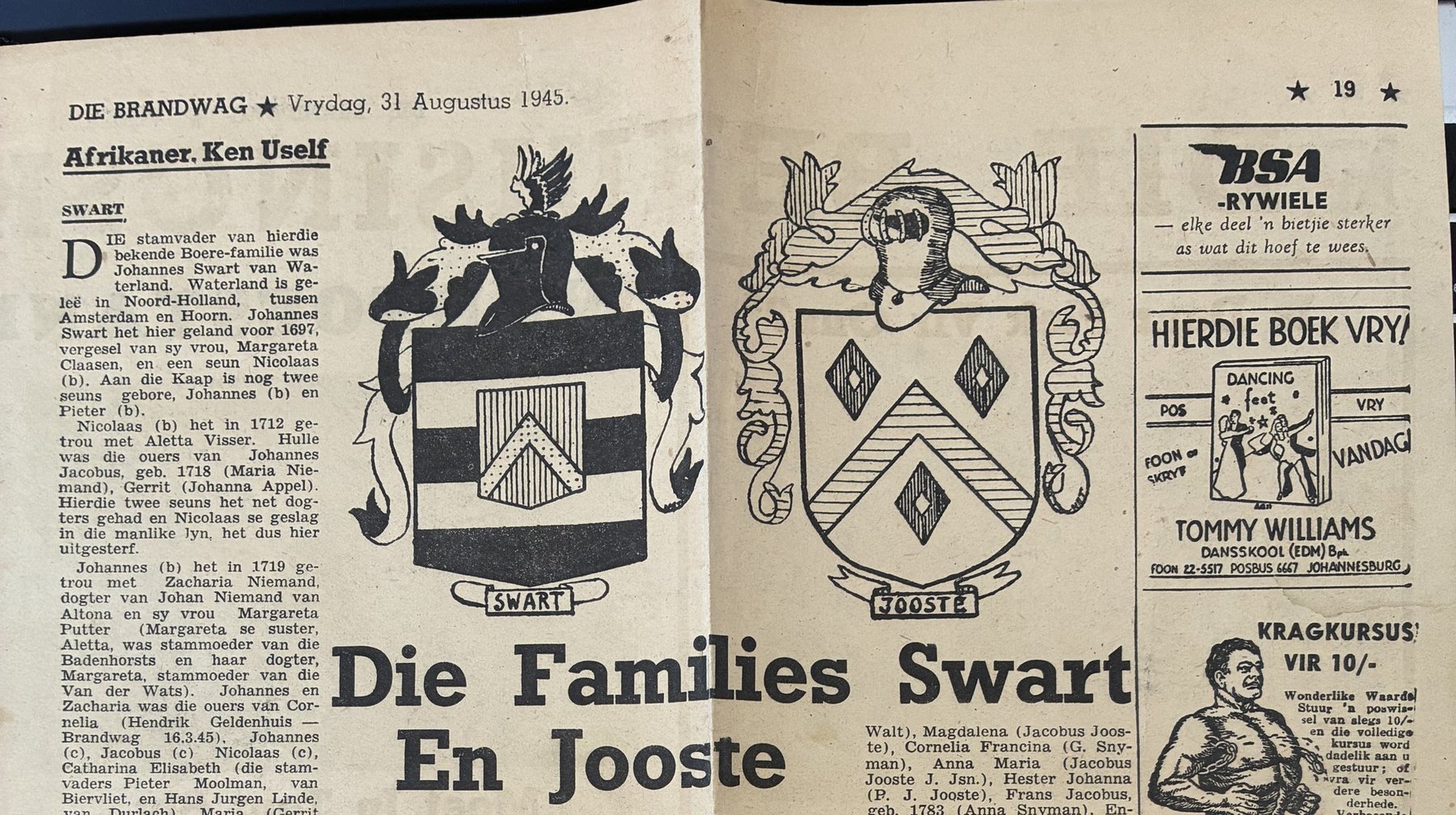
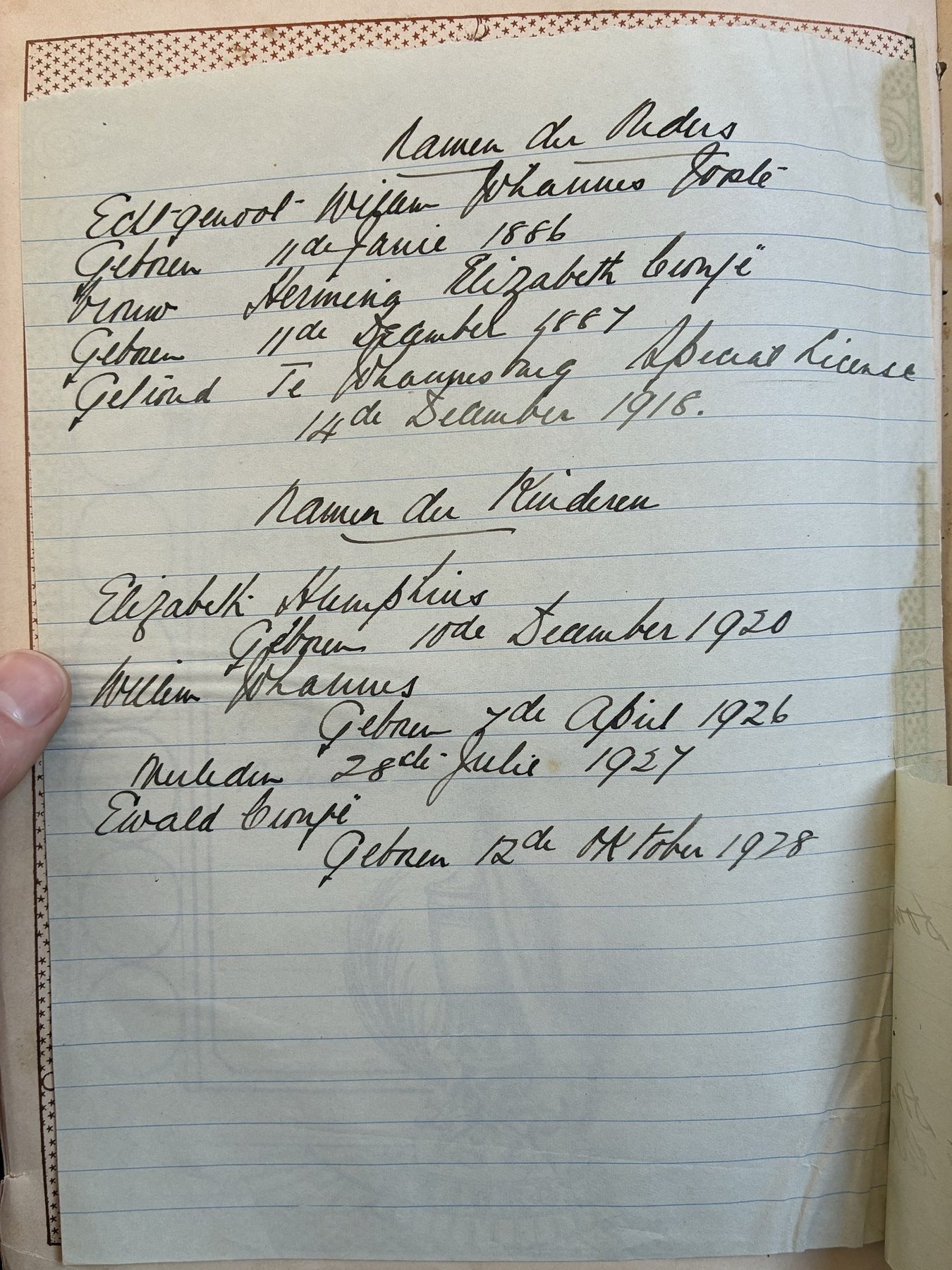
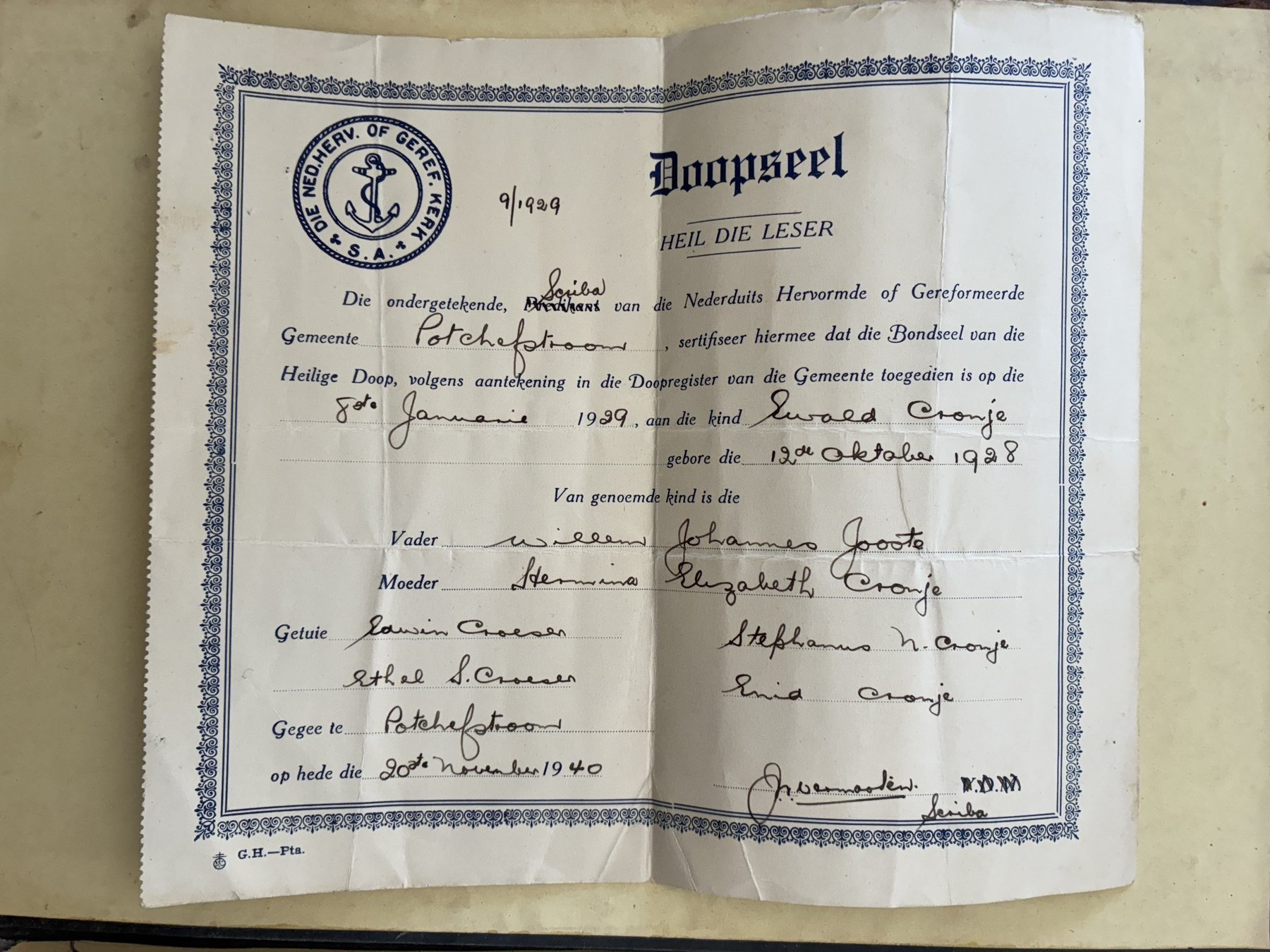
A name that travels as a given name — Cronjé, Humphries, Ewald three times over. A place that returns — Tulbagh, three marriages in a hundred and fifty years. A faith, a farm, a trade, a way of speaking. And the things kept: Willem J. Jooste was given a Dutch Bible in the Transvaal on 15 September 1881; the family wrote its births and marriages in it and tucked its papers between the pages. Three of those papers carry your card.
How to read this record
Every statement in it says where it comes from — the Bible, a court file from 1714, an estate file from 1906, a workbook kept at home, a newspaper from 1945. Where the record is sure, it says so. Where it is not, it says that too, in three small numbers you will see beside some facts: B for how much it believes, D for how much it doubts, U for what it does not know.
Some things are marked contested. The family's coat of arms, for instance, has been on the gate and in print since 1945 — and the same shield belongs, in the old armorials of 1884, to a different family, the Joosts of Holland. The record shows both, and does not decide for you.
And some fields are left open on purpose. House Fish, Charmeon's side, had one saved document and no arms when this page was first written. It has a room of its own now — seven generations running back from Bathurst to a Somerset parish in 1657, the two farms on Exmoor, the forge and the foundry, and an honest account of the coat they never had. The shield on your card still shows that half open, because the looking was done properly and the answer was no.
What only you can tell
The record reads old handwriting as well as it can, and then stops. Two people at this table can read the rest.
- The year on the Bible page. The workbook says your grandparents married on 14 December 1914; the hand-written page reads 1916 or 1918. One look at the original settles it.
- Your father's baptism certificate. The record reads it as Potchefstroom, 8 January 1929, mother Hermina Elizabeth Cronje. Is that right?
- Charmeon's family. The Fish lineage you saved stops before your generation. Your father's and grandfather's names and places; whether the family is the Joe Fish who came from Bristol to Cape Town; who found the page, and what the family knew before it.
- The Lombard and Cronje parents. Maria Magdalena Lombard's father is written as “Paul(us)…” and Hermina Elizabeth Cronje's parents are blank. Their names start two long threads back to the Cape.
- Anything else you remember — the gate, the wall, the album the design came from, the story that the Joostes came from Italy. The record grows from what you tell it.
All of these questions, from every card, on one page for the table: What only you can tell →
All the cards
1986 · Ewald Johannes & Charmeon Theresa · Hartebeespoort
1955 · Ewald Cronjé & Maria Magdalena · Tulbagh
1914 · Willem Johannes & Hermina Elizabeth · Johannesburg
2025 · Jonty Joseph Aloisi Jooste · Sydney
1906 · the estate of Willem Johannes Jooste · Braamfontein
1889 · the estate of Willem Johannes Jooste · Potchefstroom
1714 · Frans Joosten & Maria Mouton · the founding year
1731 · Jacques Mouton · Steenwijk
The Heritage Atlas · twelve generations · The Marshalling Table